
Inventory management software evaluation: a buyer's guide
Inventory management software evaluation: architecture options, a lifecycle checklist, vendor questions and SyncVentory's answers. Score your shortlist.
Key takeaways
- Inventory management software evaluation should follow the material lifecycle, from request to approval, purchase, receipt, dispatch and reconciliation, not the on-hand total alone.
- Every stock change should be a recorded movement with a user, a time and a document, so a changed quantity can be explained later.
- Dispatch should deduct stock and update project spend in one atomic transaction, or the stock figure and the project cost will drift apart.
- Architecture options range from spreadsheets and ERP modules to standalone inventory systems, each run as SaaS or self-hosted.
- SyncVentory documents four roles, value-based approvals with 24-hour escalation, atomic delivery challans and a daily material value per project.
Inventory management software evaluation is most reliable when you follow one material through its whole life: the site’s request, the approval, the purchase order, the goods receipt, the dispatch and the reconciliation. At each step, check what the system records, who can change it and whether the stock figure, the project’s spend and the audit trail move together. This guide covers the architecture options, a lifecycle checklist, the questions to ask vendors and how to run a pilot. It is for operations, procurement and IT leads in project-based businesses, with SyncVentory’s documented answers as a worked example.
Inventory management software is a system that records items, stock levels and every movement of material between suppliers, warehouses and sites, so that the quantity on hand, the cost assigned to each project and the history behind both can be checked at any time.
Architecture options for inventory systems
Most organisations choose between four approaches. They differ in how closely they match site workflows and in how much integration they need.
| Option | Strengths | Weaknesses | Fits when |
|---|---|---|---|
| Spreadsheets | No cost to start, flexible | No movement history, no approvals, version conflicts | Very small stock, one storekeeper |
| ERP inventory module | Shares data with finance and purchasing | Workflow follows the ERP, site steps may not fit | Finance-led processes, few sites |
| Standalone inventory system | Can match warehouse and site processes closely | Needs an integration to finance | Many sites or projects, field staff |
| Project and site logistics system | Ties stock to projects, requests and dispatches | Narrower scope than a full ERP | Construction, engineering, contracting |
Each option can also be deployed in different ways. NIST’s definition of cloud computing separates SaaS, where the provider runs the infrastructure, from private cloud, provisioned for one organisation on or off premises. Decide early which you need, because it changes who handles backups, upgrades and access to the database.
The material lifecycle checklist
Use this list to script your demos. Ask each vendor to walk one item through every step with your data.
- A site raises a material request against a project.
- The request is approved, with rules that depend on value.
- A purchase order is raised and the supplier invoice is checked against it.
- Goods are received into a warehouse and stock increases.
- A dispatch document issues material to a site and stock decreases.
- The project’s spend increases by the value dispatched.
- A physical count is reconciled and any adjustment is recorded with a reason.
- A report shows what reached each site, by day and value.
Why the data model and transactions matter
A displayed quantity is only as reliable as the events behind it. The system should hold items, locations, projects, requests, orders, receipts and dispatches as separate records, with every stock change traceable to one of them. If a project can carry several tender or sub-contract codes, check the model represents that rather than forcing duplicate projects.
Dispatch is the critical write. In PostgreSQL’s words, the point of a transaction is that it “bundles multiple steps into a single, all-or-nothing operation”. Stock deduction, the outbound movement record and the project cost update should be one such operation.
Questions to ask an inventory software vendor
- Can the system show the movement history behind any quantity, with user, time and document?
- What approval rules can be set, and what happens when an approver does not act?
- Which roles exist, and can a site user raise requests without seeing stock overrides?
- How are low and zero stock detected, and who is told?
- What does the API cover, and which ERP or accounting connections are documented?
- Where does it run, which database does it use, and how is it backed up?
- How is stock valued for finance or a lender, and can the report be exported?
SyncVentory in an inventory management software evaluation
The answers below come from the SyncVentory architecture and administration documentation.
| Question | SyncVentory’s documented answer | Still to confirm |
|---|---|---|
| Lifecycle | Material request, approval, purchase order, goods receipt, delivery challan, site; requests move from submitted to under review, approved and fulfilled | Your document numbering |
| Approvals | Set per project; requests over ₹1,00,000 need project manager and finance sign-off; unapproved requests escalate after 24 hours | Your thresholds and approvers |
| Dispatch | Issuing a delivery challan deducts stock atomically, logs the outbound movement and increases project spend | Behaviour under your network conditions |
| Roles | Administrator, project manager, storekeeper, site engineer (read-only site access plus material requests) | Any extra roles you need |
| Stock alerts | Minimum stock and reorder points per SKU, with low and zero stock alerts | Who receives alerts |
| Projects | Several tender or sub-contract codes per project, each with quantity and budget | Your code structure |
| Reporting | Daily material value per project, with challans, items, rates and vehicles, exported as CSV | Your finance report formats |
| Valuation | Bank valuation haircut applied to every item, book against bank value, export or print | Your lender’s method |
| Invoices | Purchase order invoices checked with OCR parsing | Accuracy on your suppliers’ invoices |
| Platform | React client, Node.js and Express REST API, PostgreSQL 16; Docker Compose or Kubernetes, cloud or on-premises | Specific ERP connectors |
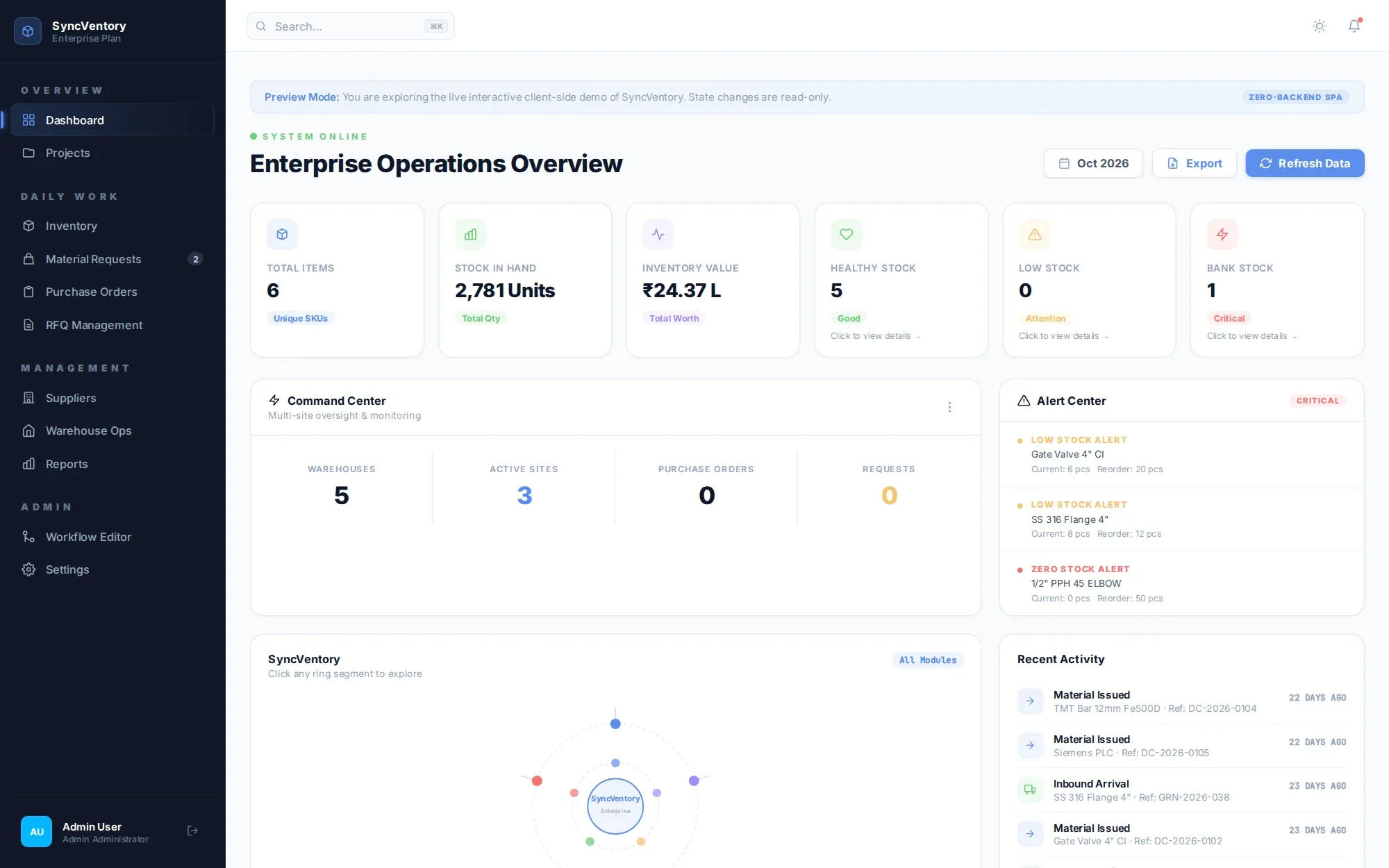 SyncVentory: the operations overview.
Security controls around the inventory system
Application roles govern who can receive, issue or adjust stock. If you host the system yourself, two more layers apply. Privileged access management controls and records administrative access to the servers and database, and database activity monitoring adds database-level evidence of who read or changed records. Neither replaces the application’s own movement history.
Run a pilot with your own data
Choose one live project and one warehouse. Load your real item codes, run the lifecycle checklist end to end, and finish with a physical count reconciled against the system. Agree beforehand what a pass looks like: for example, every dispatch traceable, every approval rule triggered as written and the daily site value matching your own records. For capacity and infrastructure, use the SyncVentory sizing and deployment guide.
Next steps
A sound inventory management software evaluation tests the full material lifecycle, the transaction behind each dispatch and the controls around the data. To walk SyncVentory through that checklist with your projects and approval rules, book a demo.
Questions
What is the difference between inventory software and an ERP inventory module?
An ERP inventory module shares one database with finance and purchasing, which simplifies accounting but ties you to the ERP's workflow. A standalone inventory system can fit site and project processes more closely, but needs an integration to pass purchases, receipts and costs to finance. Test the integration path either way.
How long should an inventory software pilot run?
Long enough to cover a full cycle of your busiest workflow, typically from material request through dispatch and a stock count. Use real item codes and at least one live project, agree pass criteria in advance, and reconcile the pilot's stock figures against a physical count at the end.
Which inventory reports matter most for project businesses?
Material sent to each project by day and value, open requests awaiting approval, stock below reorder point, and project spend against budget. These show whether material is reaching sites on time and whether project costs are visible before month end, not after it.
Do we need barcode scanning to evaluate inventory software?
Only if your receiving and issuing processes use it today or will at go-live. If they do, test scanning at a real receiving bay during the pilot, including damaged labels and items without codes. If they do not, focus the evaluation on movement records, approvals and reconciliation.
Sources
Products in this post

Keep reading
See it on your own systems
A walk-through of the products with the team that builds them.