
AI privileged access management: what it does and its limits
AI privileged access management explained: baselines, risk scoring, plain-English requests and summaries, the risks, and how to test vendor AI claims.
Key takeaways
- AI privileged access management uses statistical models and language models to help decide, explain and request privileged access; it supports policy, it does not replace it.
- The useful jobs for AI in PAM are behavioural baselines, risk scoring that ranks activity for review, plain-English access requests and summaries of long sessions or incidents.
- NIST's AI Risk Management Framework names valid and reliable, and explainable and interpretable, among the characteristics of trustworthy AI, which is the right test for any PAM risk score.
- An AI assistant that can raise or approve access is a target for prompt injection, so it should hold least privilege and leave privileged decisions to policy and people.
- Not every risk score is AI: SWOT Cloud PAM uses deterministic scoring, which is easier to explain and audit.
AI privileged access management is the use of statistical models and language models inside a PAM platform to help decide, explain and request privileged access. Done well, AI does four jobs: it learns what normal looks like for each account, scores activity so people review the riskiest sessions first, lets engineers ask for access in plain English, and summarises long sessions or incidents. It does not replace the core of PAM, which is still vaulted credentials, just-in-time grants, recorded sessions and clear policy. This guide is for security leaders and engineers who need to separate useful AI from labels, understand the risks, and test vendor claims in a proof of concept.
AI privileged access management is privileged access management in which models, rather than only fixed rules, contribute to risk scoring, anomaly detection, access requests or session review, while policy and people keep authority over what access is granted.
What AI privileged access management actually does
Most AI in PAM falls into four categories. They differ in how much they can be trusted to act on their own, so it helps to name them separately when you read a product sheet.
| AI capability | What it does | Where it helps | Main risk |
|---|---|---|---|
| Behavioural baselines | Learns each identity’s usual hours, targets and volumes | Spotting misuse that no rule describes | False positives while the baseline forms |
| Risk scoring | Combines signals into a score that ranks sessions or requests | Directing approver and analyst attention | Scores no one can explain |
| Natural-language requests | Turns a plain-English request into a structured one | Faster, more complete requests | Prompt injection; wrong scope |
| Summarising sessions and incidents | Condenses recordings and logs into a readable account | Faster review and investigation | Omissions or invented detail |
The common thread: AI is strongest at ranking and explaining, and weakest when it is the only thing between a request and a privileged action.
How behavioural baselines and risk scoring work
Zero trust architecture expects this kind of input. NIST SP 800-207 says access decisions may draw on behavioural and environmental attributes, including measured deviations from observed usage patterns, time and location. A baseline turns those attributes into a per-identity picture: the hours an account usually works, the systems it touches, the volume of data it normally reads.
A risk score then combines signals into one number that policy can act on: watch more closely, ask for a second approver, require step-up MFA, or end the session. The benefit over a single fixed rule is precision. “Alert on any access after 7 pm” fires for every maintenance window; “this account has never worked at this hour” fires far less often.
Scoring does not have to be machine learning to be useful. SWOT Cloud PAM uses deterministic scoring on escalation, exfiltration, IP, geography and timing, which routes a cloud access request to a standard approval, a second approver, or step-up MFA before anything is issued. On the database side, SWOT DAM scores each identity from 0 to 100 against its own 30-day baseline.
Natural-language access requests
Language models make requesting access easier. Instead of filling in a form, an engineer types what they need and the assistant turns it into a structured request with a target, an access level, a duration and a reason. Requests become more complete, and approvers get the context they need.
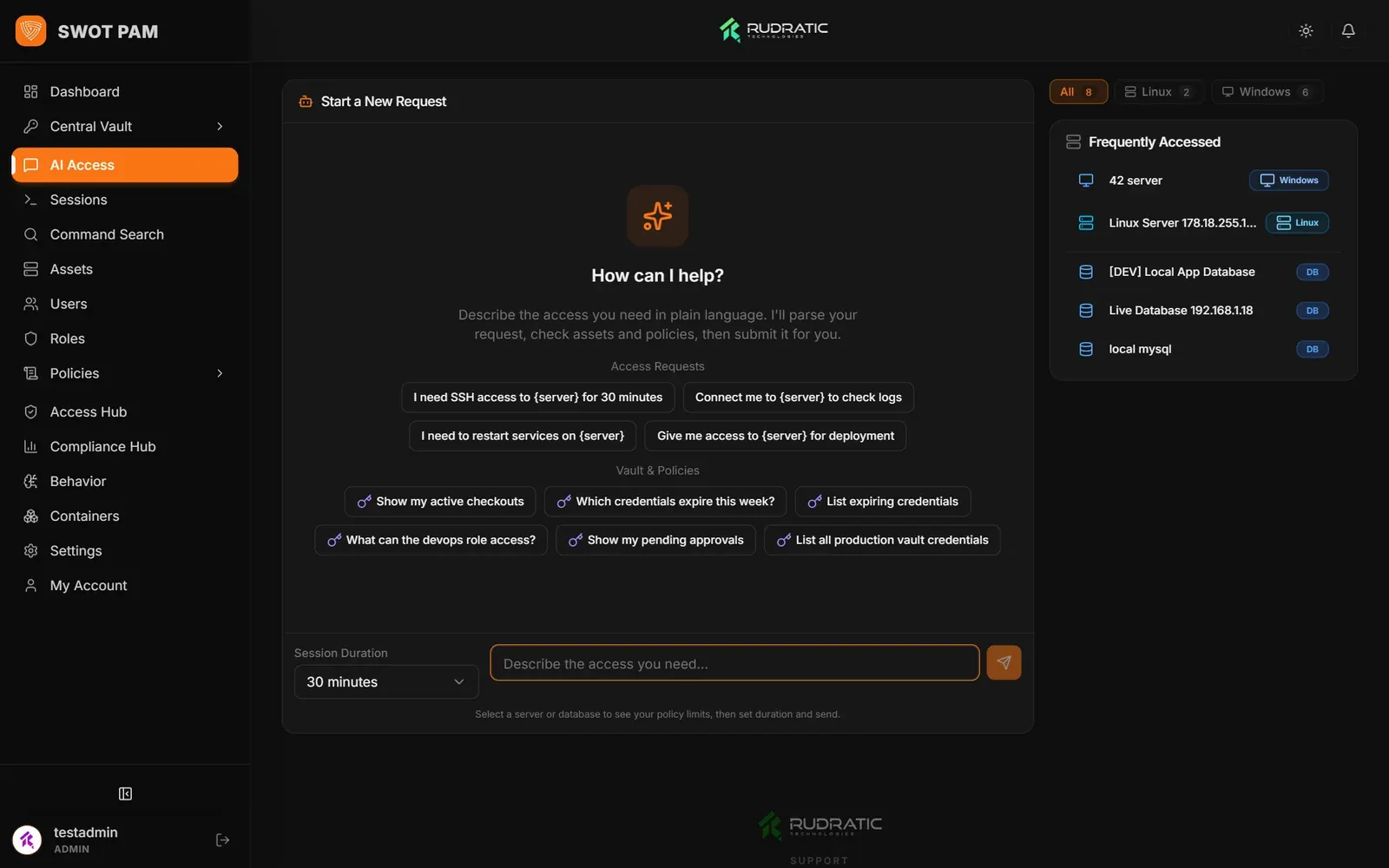 SWOT PAM: the AI access assistant.
SWOT PAM includes an AI access assistant for this. According to the SWOT PAM user guide, users can ask it to find targets, check checkout policies, follow the status of a request or ask for temporary access, for example: “I need read-only access to the billing PostgreSQL database for 2 hours to investigate incident INC-902.” The request is checked against policy before it is raised, and approval stays with the approvers your policy names, notified in Slack, Microsoft Teams or email.
Summarising sessions and incidents
A privileged session recording can run for hours, and an incident can span thousands of log lines. Language models can condense that into a readable account of what happened, why it matters and what to do next, which saves reviewer time. SWOT DAM’s AI Threat Insights works this way for database incidents: it explains the root cause and drafts the SQL to contain it, such as revoking a role.
Treat summaries as a guide to the evidence, not the evidence itself. A summary can leave out the one command that mattered. Keep the raw recording and the tamper-evident audit trail as the record of fact, and check any summary used in an investigation or audit against them.
What PAMGuard scores in a live session
SWOT PAM’s session control is PAMGuard, which the administrator guide describes as its integrated threat detection engine across all proxy sessions. Every SSH keystroke and SQL query passes through it on the way to the target. Administrators write rules as patterns and choose the action for each: block and alert, flag the session, or end it. A matching blocking rule, such as one for DROP TABLE, drops the command before the target receives it.
Flags add to the session’s risk score. At 40 the session is watched more closely, at 70 input freezes until an admin approves or ends it, and at 150 the session ends. On RDP, PAMGuard analyses keystrokes and clipboard content and flags risky desktop actions, such as opening regedit or Credential Manager. Because the rules and weights are written by your administrators, every score can be traced back to the rules that produced it.
The limits and risks of AI in PAM
AI adds new failure modes to a control that attackers already target. Plan for each one before you let a model influence access.
False positives and alert fatigue
NIST AI 100-1, the AI Risk Management Framework, lists valid and reliable among the characteristics of trustworthy AI, and says accuracy measures should consider false positive and false negative rates, tested against realistic conditions. A baseline that flags every on-call engineer at night trains people to ignore it. Ask for measured rates on data like yours, not a general claim.
Explainability
The same framework lists explainable and interpretable as a separate characteristic, and notes that explainable systems are easier to debug, monitor, document and audit. An approver who sees “risk 82” with no reasons cannot make a good decision, and an auditor cannot verify one. Every score should show its contributing factors.
Prompt injection in assistants
An assistant that can raise or act on access requests reads text that attackers can influence: ticket descriptions, chat messages, file contents. The OWASP LLM01:2025 Prompt Injection entry describes direct and indirect injection and recommends restricting the model’s privileges to the minimum necessary, keeping a human in the loop for privileged operations, and separating untrusted content from instructions.
How to evaluate AI claims from PAM vendors
“AI-powered” on a data sheet tells you nothing about what the model does or how well. Ask each vendor these questions, and test the answers in a proof of concept on your own systems.
- Which features use a learned model, which use a language model, and which are fixed rules or weights?
- What inputs feed the risk score, and does each score show the factors behind it?
- How long is the baseline period, and how does the product behave before it is complete?
- What false positive and false negative rates have you measured, on what data?
- Which actions can the system take without a person: flag, freeze, block, end, approve?
- Which model or provider does the assistant use, what data leaves our network, and can it run on our own infrastructure?
- What can the assistant do that the user cannot, and how is it protected from prompt injection?
- Are raw recordings and audit records kept alongside any summaries, and can we export both?
Next steps
AI privileged access management helps when it ranks risk, explains its reasoning, speeds up requests and condenses long sessions, with policy and people still deciding who gets access. Judge each AI feature on measured accuracy, explainability and how little privilege the model itself holds. See the AI access assistant and PAMGuard on the SWOT PAM product page, read how just-in-time access fits around them, or book a demo.
Questions
Can AI approve privileged access requests on its own?
It can if a product is built that way, but it is rarely wise for privileged roles. A safer design lets policy auto-approve narrowly defined low-risk requests, uses AI to gather context for the approver, and keeps a person as the decision-maker for anything that can change identities, data or logging.
Is deterministic risk scoring worse than machine learning?
Not necessarily. Deterministic scoring applies fixed, documented weights to known signals, so every score can be explained and reproduced for an auditor. Learned models can spot patterns no one wrote a rule for, but they need a baseline period, tuning and evidence of accuracy. Many teams use both.
How long does a behavioural baseline take to become useful?
It depends on how regular the activity is and on the product's design, so ask the vendor for the documented window. SWOT DAM, for example, scores each identity against its own rolling 30-day baseline. Expect more alerts during the first weeks and plan a tuning period before you let scores trigger automatic actions.
Does AI in PAM help with compliance?
It can help produce evidence, for example session summaries and scored activity that reviewers can sample. Frameworks judge the control, not the technology, so whether a requirement is met depends on your configuration, scope and assessment. Keep the raw records, not only AI summaries, because auditors may ask for them.
Sources
Products in this post


Keep reading
See it on your own systems
A walk-through of the products with the team that builds them.