
Zero standing privileges (ZSP): definition and how to start
Zero standing privileges explained: what ZSP is, how it differs from JIT and least privilege, and a staged plan to remove standing admin access. Read on.
Key takeaways
- Zero standing privileges (ZSP) means no human or machine identity holds privileged access by default; elevation is granted per task, for a set time, and removed automatically.
- Least privilege limits how much access an identity has; ZSP also limits when it has it.
- Just-in-time access is the mechanism that delivers ZSP: request, approve, use through a controlled session, expire.
- Standing access is the risk because a stolen or misused account inherits every right it holds at that moment, whether or not anyone is working.
- Most organisations reach ZSP in stages: find standing access, vault credentials, move the highest-impact systems to JIT, then extend to cloud and service accounts.
Zero standing privileges (ZSP) is a privilege model in which no account holds admin, root, DBA or cloud owner rights by default. When someone needs elevated access, they request it for one task, it is approved, they use it through a controlled session, and it is removed automatically when the time runs out. Between tasks there is nothing for an attacker to steal or an insider to misuse. This guide is for security leaders, identity teams and platform engineers who want a clear definition of zero standing privileges, how it relates to just-in-time access and least privilege, and a staged plan to get there.
Zero standing privileges (ZSP) is a privileged access model in which no human or machine identity keeps elevated rights by default; privileges are granted just in time for a specific task and time window, then revoked automatically.
For a short definition you can link to, see the zero standing privileges glossary entry.
Why is standing access the risk?
A standing privilege is a right that exists whether or not anyone is using it. The domain admin group membership granted for a migration two years ago, the DBA role kept “in case”, the cloud access key created for a one-off script: each one is valid at 3 a.m. on a Sunday, when nobody is working and nobody is watching.
Attackers rely on that. The Verizon 2024 Data Breach Investigations Report found that over the past ten years “stolen credentials have appeared in almost one-third (31%) of breaches.” A stolen password is only as dangerous as the rights attached to it at the moment it is used. If the account holds no admin rights by default, the attacker gets an ordinary user, not the estate.
Standing access also grows on its own. Rights are added for projects and incidents and rarely removed, shared passwords outlive the people who knew them, and cloud roles outlast the job. ZSP reverses the default: access has to be justified each time, rather than removed when someone remembers.
How do ZSP, just-in-time access and least privilege differ?
The three are related but answer different questions. NIST describes least privilege as restricting access “to the minimum necessary to accomplish assigned tasks.” That limits how much an account can do. It says nothing about when.
| Least privilege | Just-in-time (JIT) access | Zero standing privileges | |
|---|---|---|---|
| What it is | A principle | A mechanism | An end state |
| Question it answers | How much access? | How is access granted and removed? | Does anyone hold privilege by default? |
| Privilege between tasks | Still present, but scoped | Removed when the grant expires | None |
| If the account is stolen while idle | Attacker gets the scoped rights | Attacker gets whatever is not under JIT | Attacker gets no privileged rights |
| Typical controls | Role design, access reviews | Requests, approvals, time limits, auto-revocation | JIT for all privileged access, vaulted credentials, short-lived cloud credentials |
In practice you need all three. Least privilege decides what a grant should contain, just-in-time access delivers and removes it, and ZSP is what you have when no privileged right is left outside that workflow.
ZSP also fits the zero trust model. NIST SP 800-207 states that zero trust “assumes there is no implicit trust granted to assets or user accounts.” A standing admin right is exactly that kind of implicit trust.
What does a zero standing privileges request look like?
Every privileged action follows the same short lifecycle. Take an engineer investigating an incident on a billing database.
- Request: read-only access to the billing PostgreSQL database for two hours, with the incident number as the reason.
- Approve: the named approver is notified and approves; higher-risk requests may need a second approver or step-up MFA.
- Connect: the engineer connects through a proxy or gateway that injects the credential, so it never reaches their device, and the session is recorded.
- Expire: when the two hours end, the grant is removed. Nobody has to remember to take it back.
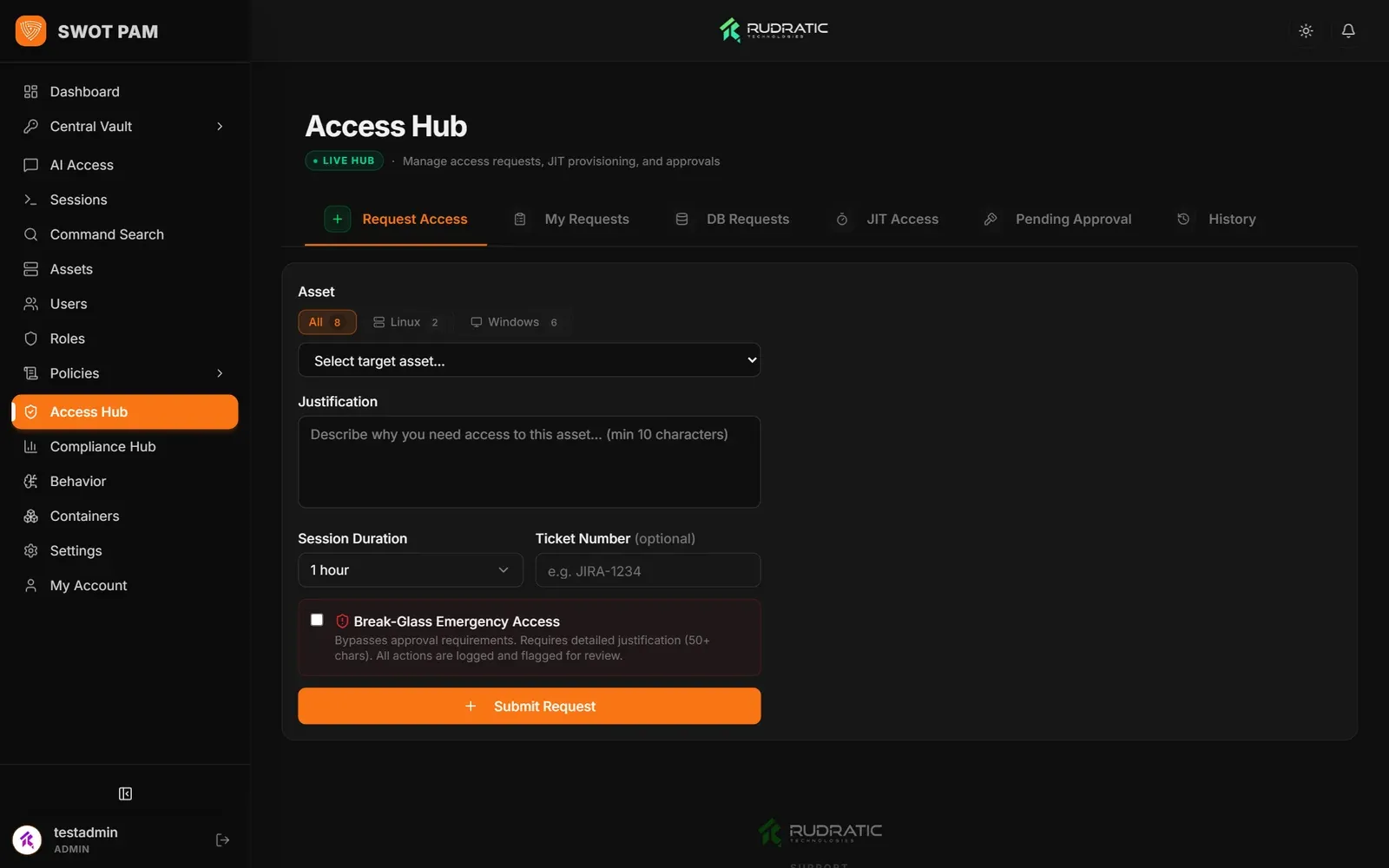 SWOT PAM: the Access Hub.
How do you get to zero standing privileges in stages?
Nobody switches every account to ZSP in one change. A staged plan keeps production running and shows results early.
Stage 1: find standing access
List every account with elevated rights: directory admin groups and their nested members, local administrators, sudo rules, database roles, cloud roles and access keys, service accounts and vendor logins. Give each an owner. Expect to find more than the directory alone shows, because privilege also comes from local groups and nested membership.
Stage 2: take the passwords away
Move shared, admin and service credentials into a vault. People check out access rather than knowing passwords, and credentials rotate after use or on a schedule. Before you rotate anything, find the scripts, scheduled tasks and integrations that use it.
Stage 3: move the highest-impact systems to just-in-time
Start with the systems where an unauthorised change would hurt most: production databases, payment systems, domain controllers, cloud owner roles. Remove standing group membership and replace it with time-bound, approved grants. Route low-risk requests quickly so engineers do not look for workarounds.
Stage 4: extend to cloud and machine identities
Replace long-lived cloud keys with short-lived credentials. AWS documents that temporary security credentials “can be configured to last for anywhere from a few minutes to several hours” and, after they expire, “AWS no longer recognizes them or allows any kind of access.” For service accounts, issue credentials at run time where the platform supports it and vault and rotate the rest.
Stage 5: prove it and keep it
Record every request, approval, session and expiry on an audit trail that shows if it has been changed. Re-run the stage 1 discovery on a schedule to catch new standing access, and report the count of standing privileged accounts as the measure of progress.
ZSP readiness checklist
- Every privileged account, human and machine, is listed with an owner.
- No person knows the password of a shared admin or root account.
- Admin rights on production systems are granted per task with an expiry, not by group membership.
- Every grant records the requester, approver, reason, target and duration.
- Cloud administration uses short-lived credentials; no long-lived access keys for people.
- Privileged sessions run through a proxy or gateway and are recorded.
- Break-glass access is tested, alerted and reviewed after each use.
- Discovery runs on a schedule and new standing access is removed or justified.
How do SWOT PAM and SWOT Cloud PAM support zero standing privileges?
The SWOT platform covers each stage, as set out on the zero standing privileges solution page.
- Find standing access: SWOT Radar records the local admins, sudo and wheel members and SSH users on each host and follows nested AD groups down to five levels. SWOT DAM scores every database identity against its own 30-day baseline.
- Take the passwords away: the SWOT PAM Central Vault holds passwords, SSH keys, cloud keys and API tokens, encrypted with AES-256-GCM, and rotates them on a schedule or as soon as a credential is checked back in.
- Just-in-time access to servers and databases: engineers request a target, a duration and a reason, or ask the AI assistant in plain English. Approvers are notified in Slack, Microsoft Teams or email. The proxy injects the credential, each database session gets a temporary account revoked at disconnect, and the grant ends on its own. Break-glass overrides are logged and alerted at high priority.
- Cloud without standing keys: SWOT Cloud PAM brokers time-bound grants behind multi-stage approval into short-lived STS AssumeRole or Azure and GCP OAuth credentials, with no persistent keys. Deterministic risk scoring can require a second approver or step-up MFA, a revoked grant stops working within 60 seconds, and break-glass needs dual control.
- Prove it: SWOT PAM seals each audit event in a SHA-256 hash chain, and SWOT Cloud PAM records sessions on a hash chain anchored by a server key that clients never hold.
Next steps
Zero standing privileges removes the admin rights an attacker or insider could use between tasks, by granting access just in time and taking it back automatically. Get there in stages: find standing access, vault credentials, move the highest-impact systems to JIT, then extend to cloud and machine identities. See how SWOT PAM delivers zero standing privileges on your own systems, or book a demo.
Questions
Is zero standing privileges the same as zero trust?
No. Zero trust is a wider architecture in which no user or device is trusted by default and every access request is authenticated and authorised. Zero standing privileges applies that idea to privileged rights specifically: no account keeps admin access between tasks. ZSP is one practical way to put zero trust into effect for administrators.
Can every account reach true zero standing privileges?
Not always. Some legacy systems need a permanent local account, and break-glass accounts must exist for outages. Treat those as managed exceptions: vault the credential, rotate it after use, require approval or dual control to release it, record every use and review it afterwards. The goal is that no person holds the right by default.
Does zero standing privileges slow engineers down?
It adds a request step, so the workflow must be fast. Let engineers ask from the tools they already use, route low-risk requests to a single approver, notify approvers in chat, and connect them straight into the session once approved. If requests take too long, people fall back to shared passwords, which defeats the purpose.
How does ZSP apply to service accounts?
Service accounts rarely log in interactively, so ZSP for them means short-lived credentials issued at run time instead of permanent keys, narrow scopes, and rotation of any secret that must persist. On AWS, temporary credentials from AWS STS expire on their own and cannot be reused, which removes the long-lived key entirely.
Sources
Products in this post


Keep reading
See it on your own systems
A walk-through of the products with the team that builds them.